Register a Surface With ICP#
Download Python source code | Download Jupyter notebook
Recover the rigid transform between two surfaces with iterative closest point.
Implemented behind pyvista.DataSetFilters.align().
import numpy as np
import pyvista as pv
from pyvista import examples
Load a Reference Surface#
The download_action_figure() scan is an
asymmetric reference mesh.
A camera position that frames the figure clearly.
cpos = pv.CameraPosition(
    position=(150, -250, 150),
    focal_point=(0, 0, 35),
    viewup=(0, 0, 1),
)
Transform a Copy Away From the Reference#
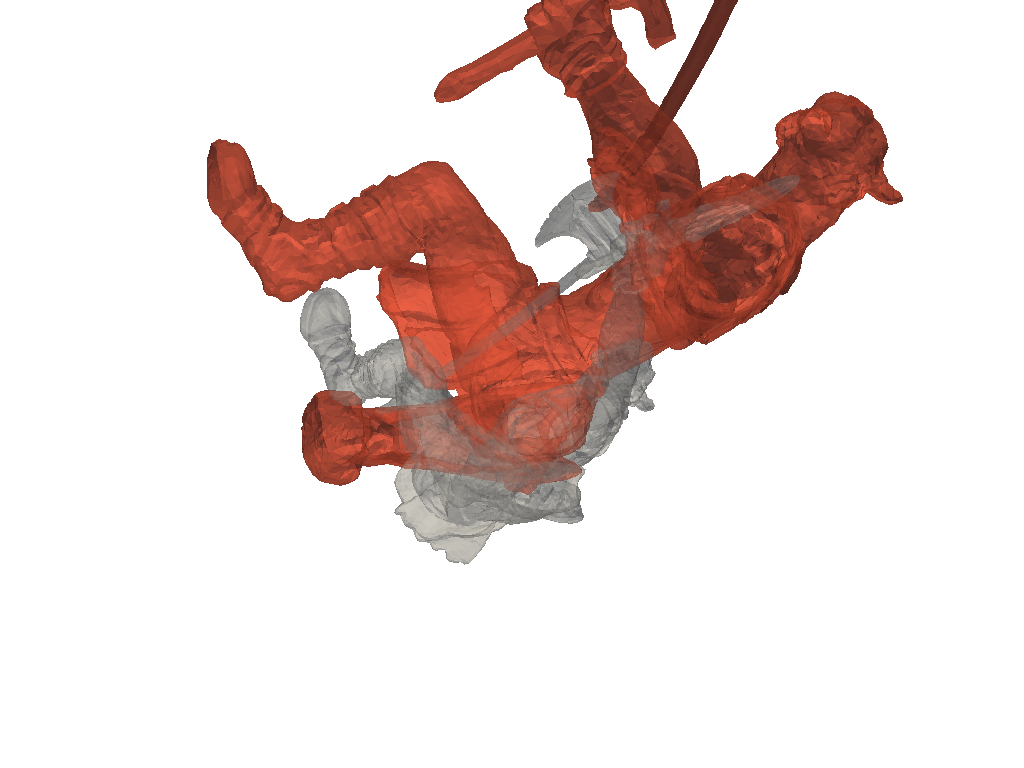
The transformed copy stands in for an incoming scan that needs to be registered back onto the reference.
offset = np.array(target.length) * 0.4
transform = pv.Transform().rotate_x(25).rotate_z(-35).translate((offset, -offset, offset))
source = target.transform(transform, inplace=False)

pl = pv.Plotter()
pl.add_mesh(target, color='lightgray', opacity=0.6)
pl.add_mesh(source, color='tomato', opacity=0.8)
pl.camera_position = cpos
pl.show()
Recover the Rigid Transform#
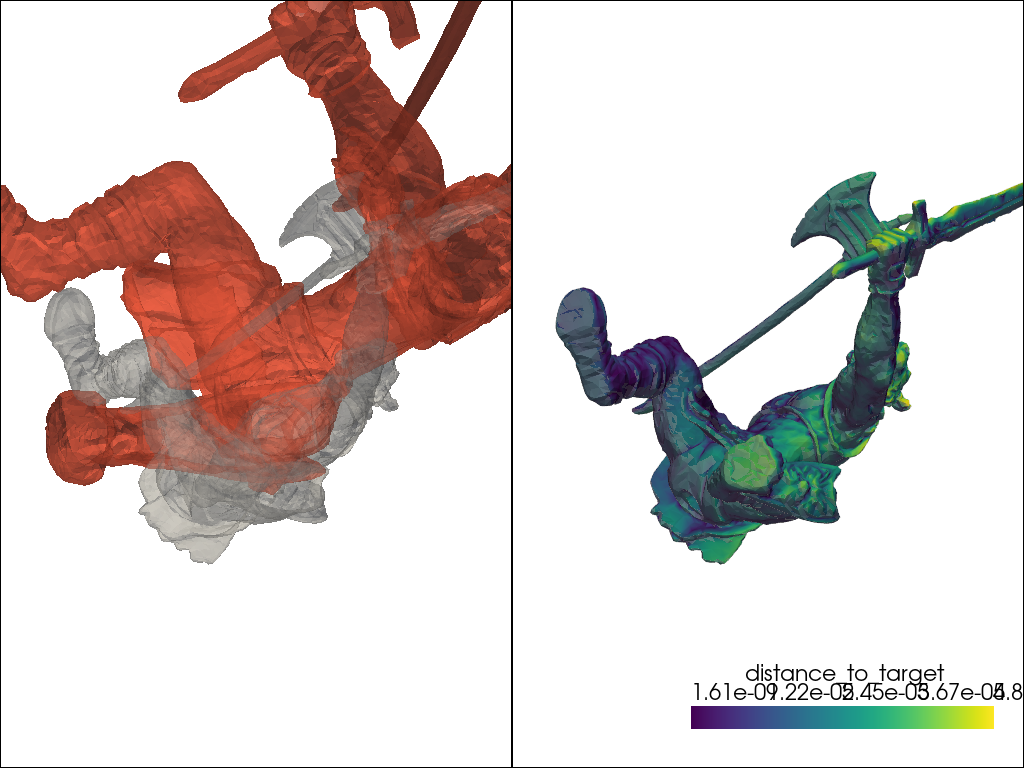
pyvista.DataSetFilters.align() runs ICP and returns both the aligned
mesh and the recovered transform matrix.
aligned, matrix = source.align(target, return_matrix=True)

_, closest_points = target.find_closest_cell(aligned.points, return_closest_point=True)
aligned['distance_to_target'] = np.linalg.norm(aligned.points - closest_points, axis=1)

pl = pv.Plotter(shape=(1, 2))
pl.subplot(0, 0)
pl.add_mesh(target, color='lightgray', opacity=0.6)
pl.add_mesh(source, color='tomato', opacity=0.8)
pl.camera_position = cpos
pl.subplot(0, 1)
pl.add_mesh(target, color='lightgray', opacity=0.4)
pl.add_mesh(aligned, scalars='distance_to_target', cmap='viridis')
pl.camera_position = cpos
pl.link_views()
pl.show()
Inspect the Recovered Transform#
The returned matrix maps the transformed copy back onto the reference.
array([[  0.819,  -0.574,  -0.   , -93.122],
       [  0.52 ,   0.742,   0.423, -13.376],
       [ -0.242,  -0.346,   0.906, -67.538],
       [  0.   ,   0.   ,   0.   ,   1.   ]])
Measure the Residual Distances#
A successful registration leaves a small point-to-surface residual.
(np.float64(1.5467277336856347e-05), np.float64(4.892452988130443e-05))
Total running time of the script: (0 minutes 0.797 seconds)