Plotter.add_axes_at_origin#
- Plotter.add_axes_at_origin(
- *,
- x_color: ColorLike | None = None,
- y_color: ColorLike | None = None,
- z_color: ColorLike | None = None,
- xlabel: str = 'X',
- ylabel: str = 'Y',
- zlabel: str = 'Z',
- line_width: int = 2,
- labels_off: bool = False,
Add axes actor at origin.
- Parameters:
- x_color
ColorLike, optional The color of the x axes arrow.
- y_color
ColorLike, optional The color of the y axes arrow.
- z_color
ColorLike, optional The color of the z axes arrow.
- xlabel
str, default: “X” The label of the x axes arrow.
- ylabel
str, default: “Y” The label of the y axes arrow.
- zlabel
str, default: “Z” The label of the z axes arrow.
- line_width
int, default: 2 Width of the arrows.
- labels_offbool, default:
False Disables the label text when
True.
- x_color
- Returns:
- vtkAxesActor
Actor of the axes.
Examples#
Download Python source code | Download Jupyter notebook
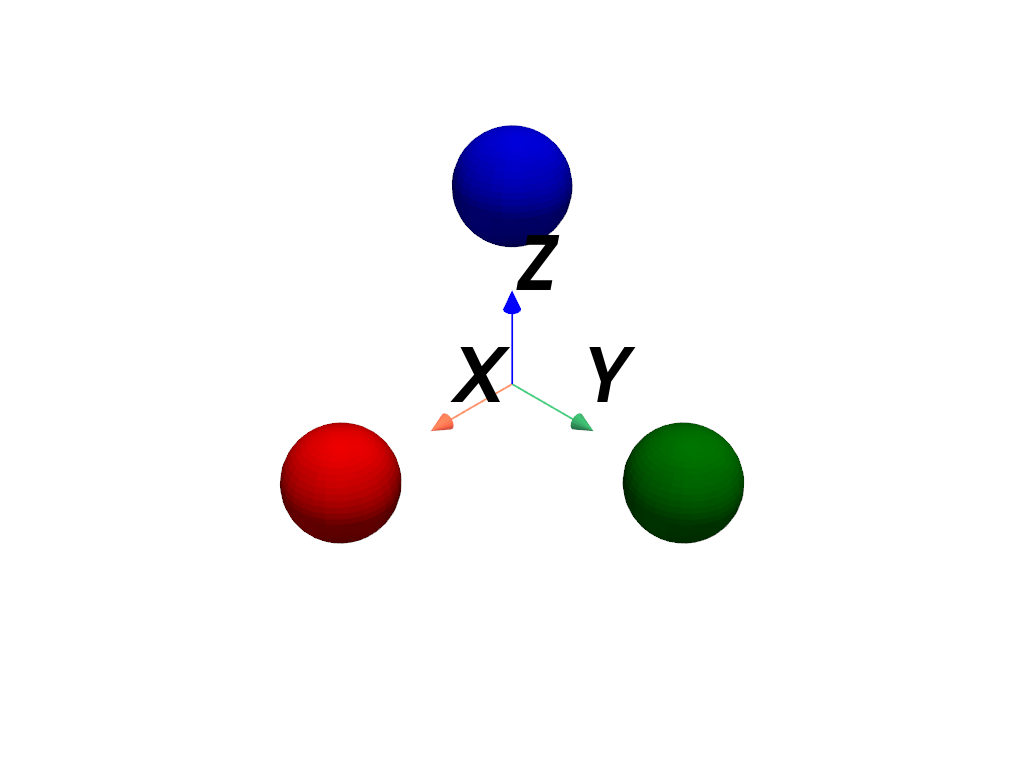
>>> import pyvista as pv
>>> pl = pv.Plotter()
>>> _ = pl.add_mesh(pv.Sphere(center=(2, 0, 0)), color='r')
>>> _ = pl.add_mesh(pv.Sphere(center=(0, 2, 0)), color='g')
>>> _ = pl.add_mesh(pv.Sphere(center=(0, 0, 2)), color='b')
>>> _ = pl.add_axes_at_origin()
>>> pl.show()
See Also#
Used In#
API Examples
DataObjectFilters.rotate(1 use)DataObjectFilters.rotate_vector(1 use)DataObjectFilters.rotate_x(1 use)DataObjectFilters.rotate_y(1 use)DataObjectFilters.rotate_z(1 use)6 more
ImageData.origin(1 use)Label(1 use)Prop3D.orientation(1 use)Renderer.add_axes_at_origin(1 use)Transform(1 use)_Prop3DMixin.orientation(1 use)
Gallery Examples