vector_poly_data#
- vector_poly_data(
- orig: VectorLikeFloat | MatrixLikeFloat,
- vec: VectorLikeFloat | MatrixLikeFloat,
Create a pyvista.PolyData object composed of vectors.
- Parameters:
- orig
VectorLikeFloat|MatrixLikeFloat Array of vector origins.
- vec
VectorLikeFloat|MatrixLikeFloat Array of vectors.
- orig
- Returns:
pyvista.PolyDataMesh containing the
origpoints along with the'vectors'and'mag'point arrays representing the vectors and magnitude of the vectors at each point.
Examples#
Download Python source code | Download Jupyter notebook
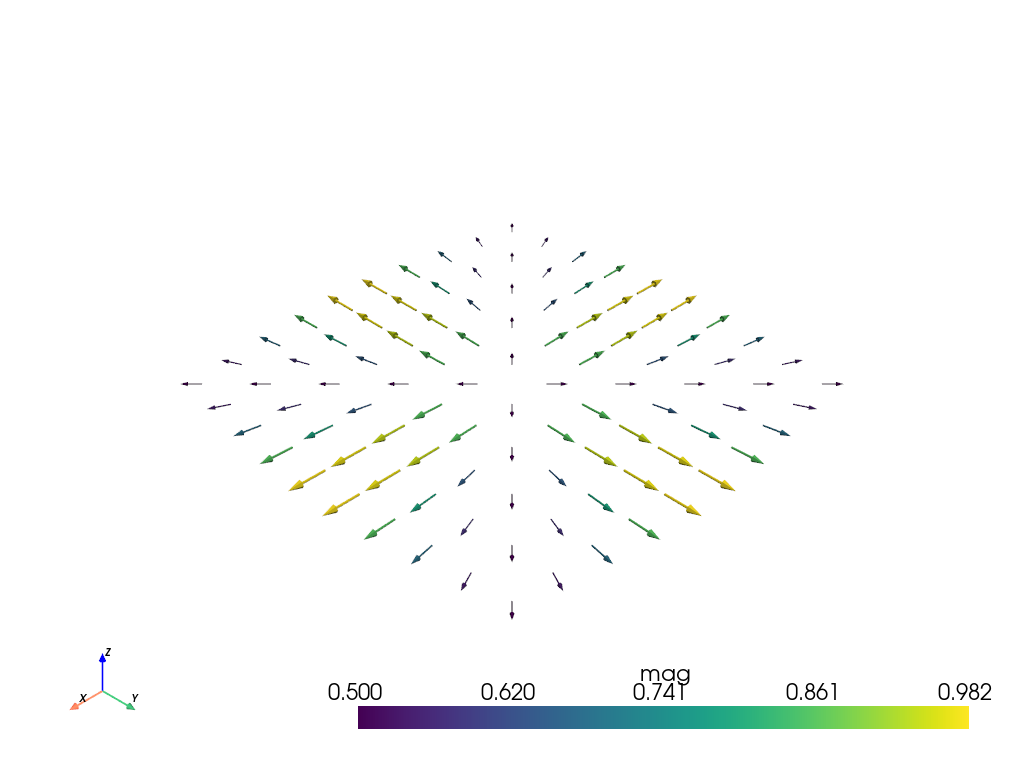
Create basic vector field. This is a point cloud where each point has a vector and magnitude attached to it.
>>> import pyvista as pv
>>> import numpy as np
>>> x, y = np.meshgrid(np.linspace(-5, 5, 10), np.linspace(-5, 5, 10))
>>> points = np.vstack((x.ravel(), y.ravel(), np.zeros(x.size))).T
>>> u = x / np.sqrt(x**2 + y**2)
>>> v = y / np.sqrt(x**2 + y**2)
>>> vectors = np.vstack((u.ravel() ** 3, v.ravel() ** 3, np.zeros(u.size))).T
>>> pdata = pv.vector_poly_data(points, vectors)
>>> pdata.point_data.keys()
['vectors', 'mag']
Convert these to arrows and plot it.
>>> pdata.glyph(orient='vectors', scale='mag').plot()