PolyData.verts#
- property PolyData.verts: NDArray[np.signedinteger][source]#
Return or set the vertex padded connectivity array.
Like all padded VTK connectivity arrays, the array is structured as:
[n0, p0_0, p0_1, ..., p0_n, n1, p1_0, p1_1, ..., p1_n, ...]
where
n0is the number of points in vertex 0, andpX_Yis point Y in vertex X.Vertices can be a single
VERTEXcell with connectivity to a single point, or aPOLY_VERTEXwith connectivity to multiple points.For example, a single vertex and polyvertex with five points might be represented as:
[1, 0, 5, 3, 2, 4, 1, 5]
Where the two separate vertex cells are
[1, 0]and[5, 3, 2, 4, 1, 5].- Returns:
numpy.ndarrayArray of vertex cell connectivity.
Examples#
Download Python source code | Download Jupyter notebook
Create a point cloud polydata and return the vertex cells.
>>> import pyvista as pv
>>> import numpy as np
>>> rng = np.random.default_rng(seed=0)
>>> points = rng.random((5, 3))
>>> pdata = pv.PolyData(points)
>>> pdata.verts
array([1, 0, 1, 1, 1, 2, 1, 3, 1, 4]...)
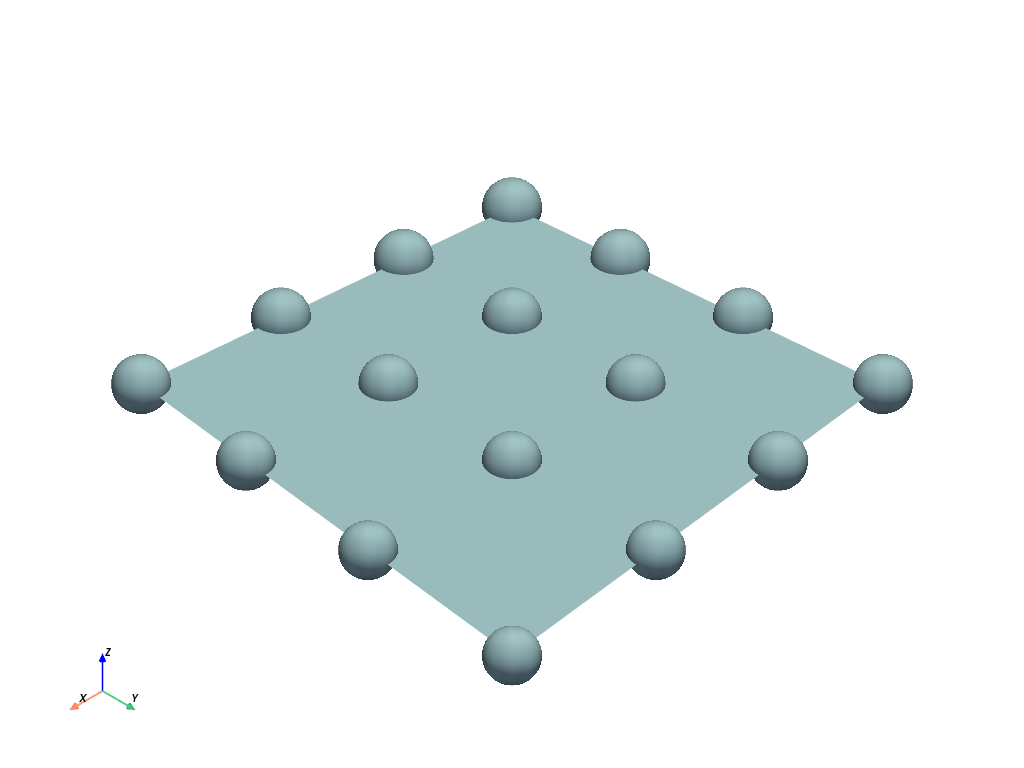
Set vertex cells. Note how the mesh plots both the surface mesh and the additional vertices in a single plot.
>>> mesh = pv.Plane(i_resolution=3, j_resolution=3)
>>> mesh.verts = np.vstack(
...     (
...         np.ones(mesh.n_points, dtype=np.int64),
...         np.arange(mesh.n_points),
...     )
... ).T
>>> mesh.plot(
...     color='lightblue',
...     render_points_as_spheres=True,
...     point_size=60,
... )
Vertex cells can also be set to a CellArray. The following
verts assignment is equivalent to the one above.
>>> mesh.verts = pv.CellArray.from_regular_cells(
...     np.arange(mesh.n_points).reshape((-1, 1))
... )
See Also#
Used In#
API Examples
PolyData.vert_connectivity(1 use)PolyData.vert_offsets(1 use)