Sample Function: Perlin Noise in 3D#
Download Python source code | Download Jupyter notebook
Sample 3D Perlin noise using sample_function().
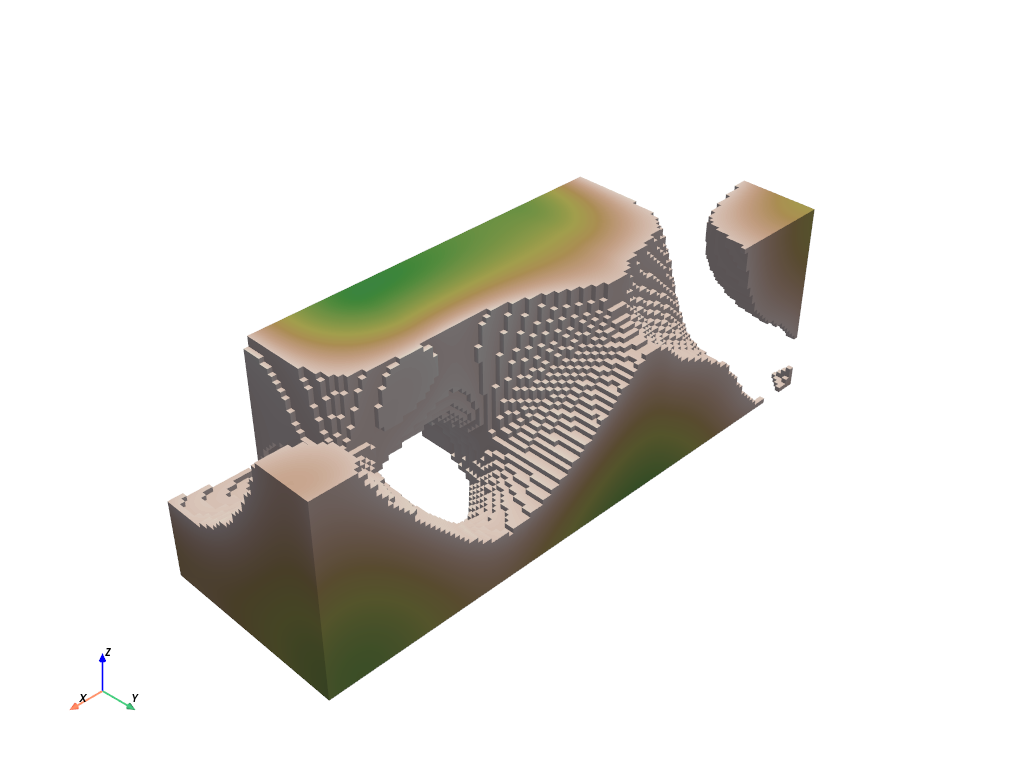
Video games like Minecraft use Perlin noise to create terrain. Here, we create a voxelized mesh similar to a Minecraft “cave”.
import pyvista as pv
Generate Perlin Noise Over a 3D StructuredGrid#
Feel free to change the values of freq to change the shape of
the “caves”. For example, lowering the frequency will make the
caves larger and more expansive, while a higher frequency in any
direction will make the caves appear more “vein-like” and less open.
Change the threshold to reduce or increase the percent of the terrain that is open or closed
freq = (1, 1, 1)
noise = pv.perlin_noise(1, freq, (0, 0, 0))
grid = pv.sample_function(noise, bounds=[0, 3.0, -0, 1.0, 0, 1.0], dim=(120, 40, 40))
out = grid.threshold(0.02)
out
color limits without blue
Total running time of the script: (0 minutes 0.470 seconds)