download_procedural_cow#
- download_procedural_cow(*, load: bool = True) PolyData | str[source]#
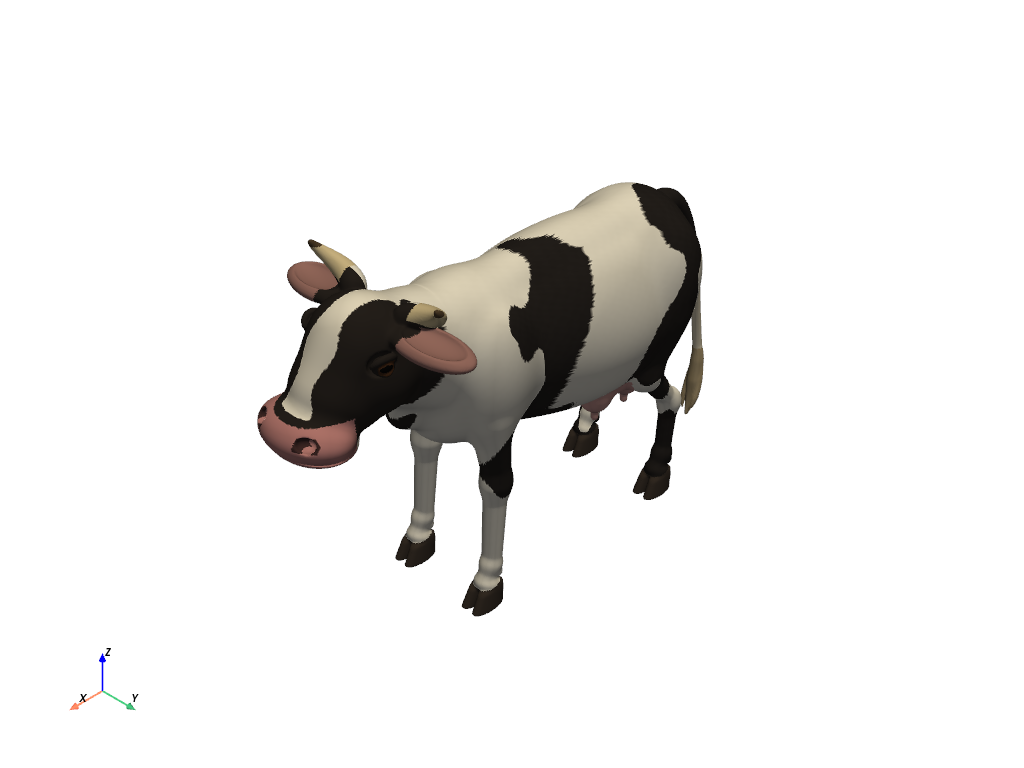
Download a procedurally generated cow.
A watertight surface of 300,000 triangles with its coat in the active
'RGB'point array. Loading requires thepyvista-zstdpackage (pip install pyvista[io]).Added in version 0.50.
generate_cow.py
The script in the PyVista data repository that sums signed distance fields into this mesh. Run it with
uv run --locked generate_cow.py.# /// script # requires-python = ">=3.13,<3.14" # dependencies = [ # "numpy>=2.2,<3", "scipy>=1.15,<2", "pyvista>=0.48.4,<0.50", # "pyvista-zstd>=0.3.1,<0.4", # ] # /// """Generate a colored 300,000-triangle cow in PyVista's native .pv format. Run ``uv run --locked generate_cow.py`` to write only ``cow.pv``. Use ``--preview-dir /tmp/cow-preview`` for optional hoof and full-cow renders. The same hoof construction is used in the isolated study and the full cow. This script was generated by GPT-6 (Astra). """ from __future__ import annotations import argparse import time from dataclasses import dataclass from pathlib import Path import numpy as np import pyvista as pv from scipy.interpolate import CubicSpline from scipy.ndimage import gaussian_filter ROOT = Path(__file__).resolve().parent class ImplicitSurface: """Bounded float32 SDF; each primitive updates only its local voxel box.""" def __init__(self, low, high, step): self.low = np.array(low, dtype=float) self.step = step self.axes = [ np.arange(a, b + step, step, dtype=np.float32) for a, b in zip(low, high) ] self.field = np.full(tuple(len(a) for a in self.axes), 0.3, np.float32) def region(self, lo, hi): starts = np.maximum( 0, np.floor((np.array(lo) - self.low) / self.step).astype(int) ) stops = np.minimum( self.field.shape, np.ceil((np.array(hi) - self.low) / self.step).astype(int) + 1, ) slices = tuple((slice(a, b) for a, b in zip(starts, stops))) xyz = [ self.axes[0][slices[0]][:, None, None], self.axes[1][slices[1]][None, :, None], self.axes[2][slices[2]][None, None, :], ] return (slices, xyz) def combine(self, slices, d, blend, cut): old = self.field[slices] if cut: d = -d if blend: h = np.maximum(blend - np.abs(old - d), 0) / blend self.field[slices] = np.maximum(old, d) + h * h * blend * 0.25 else: self.field[slices] = np.maximum(old, d) elif blend: h = np.maximum(blend - np.abs(old - d), 0) / blend self.field[slices] = np.minimum(old, d) - h * h * blend * 0.25 else: self.field[slices] = np.minimum(old, d) def ellipsoid(self, c, r, blend=0.05, ry=0, basis=None, cut=False): c, r = (np.array(c), np.array(r)) if basis is None: co, si = (np.cos(ry), np.sin(ry)) basis = np.array([[co, 0, si], [0, 1, 0], [-si, 0, co]]) bounds = np.abs(basis) @ r + blend + 0.025 slices, xyz = self.region(c - bounds, c + bounds) q = [xyz[i] - c[i] for i in range(3)] local = [sum(basis[j, i] * q[j] for j in range(3)) for i in range(3)] k0 = np.sqrt(sum((local[i] / r[i]) ** 2 for i in range(3))) k1 = np.sqrt(sum((local[i] / r[i] ** 2) ** 2 for i in range(3))) d = k0 * (k0 - 1) / np.maximum(k1, 1e-08) d = np.where(k0 < 1e-05, -min(r), d) self.combine(slices, d, blend, cut) def segment(self, a, b, ra, rb, blend=0.025, cut=False): a, b = (np.array(a), np.array(b)) pad = max(ra, rb) + blend + 0.02 slices, xyz = self.region(np.minimum(a, b) - pad, np.maximum(a, b) + pad) v = b - a q = [xyz[i] - a[i] for i in range(3)] t = np.clip(sum(q[i] * v[i] for i in range(3)) / np.dot(v, v), 0, 1) d = np.sqrt(sum((q[i] - t * v[i]) ** 2 for i in range(3))) - ( ra + (rb - ra) * t ) self.combine(slices, d, blend, cut) def curve(self, points, radii, blend=0.02, cut=False, samples=36): t = np.linspace(0, 1, len(points)) u = np.linspace(0, 1, samples) p = CubicSpline(t, points, axis=0)(u) r = np.interp(u, t, radii) for i in range(samples - 1): self.segment(p[i], p[i + 1], r[i], r[i + 1], blend, cut) def head_point(self, point): p = np.array(point, dtype=float) p[1] *= 1.18 p[2] -= 0.24 return p def head_ellipsoid(self, c, r, *args, **kwargs): r = np.array(r, dtype=float) r[1] *= 1.18 self.ellipsoid(self.head_point(c), r, *args, **kwargs) def head_curve(self, points, radii, *args, **kwargs): self.curve([self.head_point(p) for p in points], radii, *args, **kwargs) @dataclass(frozen=True) class HoofConfig: length: float = 0.25 width: float = 0.20 height: float = 0.155 top_setback: float = 0.043 toe_gap: float = 0.014 crown_blend: float = 0.020 def hoof_claw(s, xh, yh, side, h): """An oval, rearward-sloping claw with a flatter medial wall and rounded crown.""" slices, xyz = s.region( (xh - h.length, yh - h.width, -0.045), (xh + h.length, yh + h.width, h.height + 0.07), ) x, y, z = xyz t = np.clip(z / h.height, 0, 1) # Ground footprint is oval. Each wall tapers and leans back towards the coronet. center_x = xh + 0.008 - h.top_setback * t rx = h.length * (0.50 - 0.145 * t) ry = h.width * (0.267 - 0.046 * t) center_y = yh + side * h.width * (0.233 - 0.032 * t) ellipse = np.sqrt(((x - center_x) / rx) ** 2 + ((y - center_y) / ry) ** 2) wall = (ellipse - 1) * ry # A continuous interdigital cleft; it widens towards the toe. front = np.clip((x - xh + h.length * 0.35) / (h.length * 0.8), 0, 1) gap = h.toe_gap * (0.24 + 0.76 * front) medial = gap / 2 - side * (y - yh) wall = np.maximum(wall, medial) # Smoothly round the coronet rather than making a horizontal box top. roof = z - (h.height - 0.19 * (x - xh)) k = 0.035 blend = np.maximum(k - np.abs(wall - roof), 0) / k d = np.maximum(wall, roof) + blend * blend * k * 0.25 s.combine(slices, d, 0.004, False) def add_foot(s, xh, yh, h, hind=False, lower_leg=True): """Shared for isolated studies and all four feet of the assembled cow.""" for side in (-1, 1): hoof_claw(s, xh, yh, side, h) # A rounded heel bulb, tucked under the coronet at the back of each claw. s.ellipsoid( (xh - 0.067, yh + side * 0.040, 0.100), (0.053, 0.042, 0.064), 0.012 ) # Skin/coronet joins both claws above the split and receives the pastern. s.ellipsoid((xh - 0.030, yh, 0.163), (0.071, 0.078, 0.042), h.crown_blend) if lower_leg: rear = -0.078 if hind else -0.068 ankle_z = 0.265 if hind else 0.275 s.ellipsoid((xh + rear, yh, ankle_z), (0.075, 0.070, 0.078), 0.025) s.segment( (xh + rear, yh, ankle_z), (xh - 0.020, yh, 0.165), 0.055, 0.064, 0.025 ) for side in (-1, 1): s.ellipsoid( (xh + rear - 0.026, yh + side * 0.042, 0.222), (0.028, 0.021, 0.035), 0.013, ) def build_cow(surface, hoof): """Populate the field with the cow anatomy and the shared hoof geometry.""" print("Sculpting torso, shoulders, neck and head", flush=True) surface.ellipsoid((-0.12, 0, 1.57), (1.07, 0.485, 0.57), 0.15) surface.ellipsoid((-0.37, 0, 1.4), (0.77, 0.48, 0.45), 0.16) surface.ellipsoid((-0.8, 0, 1.7), (0.39, 0.425, 0.46), 0.13) surface.ellipsoid((0.65, 0, 1.7), (0.39, 0.4, 0.48), 0.15) surface.ellipsoid((-0.03, 0, 2.028), (0.83, 0.17, 0.13), 0.09) surface.ellipsoid((0.97, 0, 1.82), (0.36, 0.29, 0.34), 0.15, ry=0.6) surface.ellipsoid((1.15, 0, 1.94), (0.3, 0.28, 0.29), 0.12, ry=0.45) surface.ellipsoid((0.79, 0, 1.4), (0.265, 0.28, 0.27), 0.12) surface.ellipsoid((1.03, 0, 1.53), (0.21, 0.12, 0.18), 0.08, ry=0.65) surface.head_ellipsoid((1.4, 0, 2.3), (0.275, 0.245, 0.285), 0.11, ry=-0.48) surface.head_ellipsoid((1.59, 0, 2.12), (0.215, 0.205, 0.29), 0.1, ry=-0.65) surface.head_ellipsoid((1.52, 0, 2.07), (0.245, 0.22, 0.23), 0.08) surface.head_ellipsoid((1.78, 0, 1.938), (0.23, 0.26, 0.149), 0.065, ry=-0.08) surface.head_ellipsoid((1.744, 0, 1.861), (0.215, 0.234, 0.075), 0.035) for s in [-1, 1]: surface.head_ellipsoid((1.38, s * 0.17, 2.15), (0.175, 0.105, 0.17), 0.07) print("Sculpting four articulated legs and split hooves", flush=True) for s in [-1, 1]: y = s * 0.292 surface.ellipsoid((0.67, y, 1.6), (0.22, 0.16, 0.41), 0.11, ry=-0.1) surface.segment((0.72, y, 1.36), (0.68, y * 1.04, 0.91), 0.127, 0.085, 0.06) surface.ellipsoid((0.69, y * 1.04, 0.88), (0.105, 0.094, 0.135), 0.045) surface.segment( (0.69, y * 1.04, 0.87), (0.735, y * 1.06, 0.3), 0.078, 0.064, 0.04 ) surface.ellipsoid((-0.8, y, 1.57), (0.255, 0.177, 0.4), 0.12, ry=-0.23) surface.segment((-0.78, y, 1.41), (-0.64, y * 1.08, 1.02), 0.16, 0.105, 0.075) surface.ellipsoid((-0.64, y * 1.08, 1.035), (0.125, 0.1, 0.145), 0.045) surface.segment( (-0.65, y * 1.08, 1.02), (-0.9, y * 1.11, 0.68), 0.091, 0.06, 0.035 ) surface.ellipsoid((-0.9, y * 1.11, 0.67), (0.09, 0.077, 0.105), 0.035) surface.segment( (-0.9, y * 1.11, 0.66), (-0.86, y * 1.13, 0.28), 0.063, 0.056, 0.03 ) add_foot(surface, 0.815, y * 1.07, hoof, hind=False) add_foot(surface, -0.776, y * 1.13, hoof, hind=True) print("Adding udder, ears, horns, and tail", flush=True) surface.ellipsoid((-0.51, 0, 1.025), (0.315, 0.273, 0.233), 0.1) for xx in [-0.655, -0.37]: for yy in [-0.137, 0.137]: surface.ellipsoid((xx, yy, 0.9), (0.116, 0.108, 0.125), 0.045) surface.segment( (xx, yy, 0.887), (xx + 0.014, yy * 1.08, 0.733), 0.035, 0.025, 0.022 ) for s in [-1, 1]: long = np.array([-0.15, s * 0.986, -0.07]) long /= np.linalg.norm(long) short = np.array([1.0, s * 0.11, 0]) short /= np.linalg.norm(short) normal = np.cross(short, long) if normal[2] < 0: normal *= -1 short = np.cross(long, normal) basis = np.column_stack([short, long, normal]) center = surface.head_point([1.28, s * 0.385, 2.425]) surface.ellipsoid(center, (0.143, 0.27, 0.065), 0.045, basis=basis) surface.ellipsoid( center + normal * 0.047 + long * 0.014, (0.101, 0.201, 0.042), 0.013, basis=basis, cut=True, ) surface.head_curve( [ (1.24, s * 0.177, 2.485), (1.2, s * 0.295, 2.53), (1.23, s * 0.392, 2.59), (1.29, s * 0.426, 2.673), ], [0.068, 0.051, 0.028, 0.0045], 0.023, samples=28, ) surface.head_ellipsoid( (1.47, s * 0.228, 2.328), (0.084, 0.049, 0.065), 0.013, cut=True ) surface.head_ellipsoid((1.47, s * 0.238, 2.329), (0.061, 0.044, 0.044), 0.009) surface.head_curve( [ (1.397, s * 0.236, 2.33), (1.436, s * 0.262, 2.375), (1.497, s * 0.259, 2.377), (1.535, s * 0.231, 2.339), ], [0.016, 0.019, 0.018, 0.014], 0.009, samples=20, ) surface.head_curve( [ (1.409, s * 0.243, 2.314), (1.47, s * 0.267, 2.286), (1.526, s * 0.235, 2.316), ], [0.012, 0.013, 0.012], 0.006, samples=16, ) surface.head_ellipsoid( (1.929, s * 0.157, 1.999), (0.064, 0.047, 0.039), 0.01, ry=-0.35, cut=True ) surface.head_curve( [ (1.57, s * 0.177, 1.864), (1.72, s * 0.236, 1.858), (1.88, s * 0.189, 1.87), (1.989, s * 0.035, 1.872), ], [0.006, 0.009, 0.009, 0.007], 0.003, cut=True, samples=30, ) surface.curve( [ (-1.035, 0, 1.95), (-1.23, 0.035, 1.87), (-1.37, 0.065, 1.49), (-1.44, 0.08, 1.05), (-1.46, 0.1, 0.78), (-1.46, 0.11, 0.64), ], [0.078, 0.056, 0.034, 0.026, 0.023, 0.023], 0.024, samples=64, ) surface.curve( [ (-1.46, 0.11, 0.74), (-1.463, 0.112, 0.63), (-1.445, 0.115, 0.47), (-1.411, 0.118, 0.31), (-1.374, 0.12, 0.21), ], [0.023, 0.043, 0.047, 0.027, 0.006], 0.012, samples=42, ) for side, length in [(-1, 0.0), (1, 0.025)]: surface.curve( [ (-1.463, 0.11 + side * 0.012, 0.66), (-1.452, 0.11 + side * 0.037, 0.49), (-1.415, 0.11 + side * 0.047, 0.35), (-1.385, 0.11 + side * 0.032, 0.235 + length), ], [0.024, 0.027, 0.021, 0.0045], 0.008, samples=28, ) surface.curve( [ (-1.463, 0.1, 0.61), (-1.482, 0.104, 0.45), (-1.461, 0.109, 0.3), (-1.427, 0.112, 0.232), ], [0.026, 0.023, 0.014, 0.0045], 0.008, samples=24, ) def vertex_colors(vertices): # Organic Holstein markings sampled in 3D, so the colors continue across the back. v = vertices x, y, z = v.T pattern = ( np.sin(x * 5.4 + np.sin(z * 4.4) * 0.75 + np.cos(y * 5.1)) + 0.65 * np.cos(z * 6.9 - y * 4.3 + np.sin(x * 3.1)) + 0.28 * np.sin(x * 12.5 + y * 9.2 + z * 8.3) + 0.12 * np.cos(x * 22.1 - y * 15.3 + z * 17.8) ) black = pattern > 0.36 color = np.empty((len(v), 4), dtype=np.uint8) color[:] = [235, 228, 210, 255] color[black] = [36, 32, 29, 255] # Slight coherent variation avoids a flat plastic appearance in the PLY. tone = ( 2 * np.sin(x * 75 + y * 64 + np.sin(z * 61)) * np.cos(z * 83 - y * 41) ).astype(int) color[:, :3] = np.clip(color[:, :3].astype(int) + tone[:, None], 0, 255) # Dark head with a white forehead blaze. hz = z + 0.24 hy = y / 1.18 head = (x > 1.21) & (hz > 1.91) color[head] = [39, 34, 30, 255] blaze = head & (np.abs(hy) < (0.078 + 0.018 * np.sin(hz * 19))) & (hz > 2.08) color[blaze] = [237, 229, 209, 255] muzzle = (x > 1.65) & (hz < 2.06) & (hz > 1.77) color[muzzle] = [185, 125, 120, 255] nostril = ( (x > 1.88) & (np.abs(hy) > 0.11) & (np.abs(hy) < 0.21) & (hz > 1.965) & (hz < 2.03) ) color[nostril] = [66, 43, 41, 255] udder = ( (((x + 0.51) / 0.36) ** 2 + (y / 0.31) ** 2 < 1.1) & (z < 1.025) & (z > 0.69) ) color[udder] = [206, 153, 143, 255] hooves = (z < (0.152 - 0.20 * np.where(x > 0, x - 0.815, x + 0.776))) & (z < 0.185) color[hooves] = [58, 49, 41, 255] horns = (hz > 2.51) & (x < 1.40) & (np.abs(hy) > 0.23) color[horns] = [211, 191, 145, 255] color[horns & (hz > 2.638)] = [83, 66, 45, 255] ears = (np.abs(hy) > 0.282) & (x > 1.11) & (x < 1.46) & (hz > 2.33) & (hz < 2.49) color[ears] = [155, 112, 103, 255] for s in [-1, 1]: eye = ((x - 1.47) / 0.057) ** 2 + ((hz - 2.329) / 0.043) ** 2 < 1 eye &= s * hy > 0.259 color[eye] = [68, 41, 23, 255] pupil = eye & (((x - 1.477) / 0.039) ** 2 + ((hz - 2.329) / 0.019) ** 2 < 1) color[pupil] = [10, 9, 8, 255] tail_lower = (x < -1.29) & (z < 1.40) color[tail_lower] = [224, 211, 181, 255] switch = tail_lower & (z < 0.74) # Warm pale hair with restrained variation, rendered as opaque solid geometry. hair_tone = 7 * np.sin(95 * y + 12 * z + 9 * x) color[switch, :3] = np.clip( np.array([189, 166, 123]) + hair_tone[switch, None], 0, 255 ).astype(np.uint8) return color def validate_mesh(mesh: pv.PolyData, triangles: int | None = None) -> None: """Check closure, orientation, one component, triangle quality, and volume.""" if not mesh.is_all_triangles or ( triangles is not None and mesh.n_cells != triangles ): msg = f"Expected {triangles} triangles; got {mesh.n_cells} cells" raise ValueError(msg) faces = mesh.regular_faces edges = np.concatenate((faces[:, [0, 1]], faces[:, [1, 2]], faces[:, [2, 0]])) _, inverse, counts = np.unique( np.sort(edges, axis=1), axis=0, return_inverse=True, return_counts=True ) orientation = np.bincount( inverse, weights=np.where(edges[:, 0] < edges[:, 1], 1, -1) ) if not np.all(counts == 2) or np.any(orientation): msg = "The surface must be watertight with consistently oriented faces" raise ValueError(msg) regions = mesh.connectivity(label_regions=True) if np.max(regions.cell_data["RegionId"]) != 0: msg = "The model contains disconnected anatomy" raise ValueError(msg) a, b, c = np.asarray(mesh.points, dtype=np.float64)[faces].transpose(1, 0, 2) normals = np.cross(b - a, c - a) if np.any(np.linalg.norm(normals, axis=1) <= 0): msg = "The mesh contains degenerate triangles" raise ValueError(msg) signed_volume = float(np.einsum("ij,ij->", a, np.cross(b, c)) / 6) if signed_volume <= 0: msg = "The surface must have positive, outward-oriented volume" raise ValueError(msg) def extract_surface(surface: ImplicitSurface) -> pv.PolyData: """Extract a clean, oriented surface, removing only subvoxel specks.""" gaussian_filter( surface.field, sigma=0.65, output=surface.field, mode="nearest", truncate=2 ) np.maximum(surface.field, -surface.axes[2][None, None, :], out=surface.field) grid = pv.ImageData( dimensions=surface.field.shape, spacing=(surface.step,) * 3, origin=surface.low ) grid.point_data["distance"] = surface.field.ravel(order="F") mesh = grid.contour([0], scalars="distance", method="flying_edges").triangulate() mesh = mesh.clean(tolerance=1e-7).smooth_taubin(n_iter=12, pass_band=0.12) # Cleaning may turn collapsed contour cells into lines or vertices. Keep # only the triangular surface cells, as required for this dataset. mesh = pv.PolyData(mesh.points, mesh.faces) connected = mesh.connectivity(label_regions=True) _, counts = np.unique(connected.cell_data["RegionId"], return_counts=True) if len(counts) > 1: if np.count_nonzero(counts > 100) != 1: msg = "The sculpture has separate anatomical components" raise ValueError(msg) mesh = mesh.extract_largest() mesh = mesh.compute_normals( point_normals=False, cell_normals=True, auto_orient_normals=True, consistent_normals=True, ) mesh.clear_data() validate_mesh(mesh) return mesh def reduce_mesh(mesh: pv.PolyData, triangles: int) -> pv.PolyData: """Reduce the surface and restore level soles without changing topology.""" if triangles > mesh.n_cells: msg = "Triangle target exceeds source resolution; decrease --voxel-size" raise ValueError(msg) mesh = mesh.decimate(1 - triangles / mesh.n_cells, volume_preservation=True) mesh = mesh.smooth_taubin(n_iter=12, pass_band=0.12) mesh.points[mesh.points[:, 2] < 0.003, 2] = 0 mesh.clear_data() validate_mesh(mesh, triangles) return mesh def check_soles(mesh: pv.PolyData) -> list[float]: """Require a broad flat contact patch on every hoof.""" triangles = mesh.points[mesh.regular_faces] flat = np.all(np.abs(triangles[:, :, 2]) < 1e-7, axis=1) centers = triangles[flat].mean(axis=1) a, b, c = triangles[flat].transpose(1, 0, 2) area = np.linalg.norm(np.cross(b - a, c - a), axis=1) / 2 result = [] for sx, sy in ((-1, -1), (-1, 1), (1, -1), (1, 1)): selected = (sx * centers[:, 0] > 0) & (sy * centers[:, 1] > 0) sole_area = float(area[selected].sum()) if sole_area < (mesh.bounds[1] - mesh.bounds[0]) ** 2 * 0.0005: msg = "Every hoof needs a broad coplanar sole" raise ValueError(msg) result.append(sole_area) return result def verify_round_trip(original: pv.PolyData, path: Path) -> pv.PolyData: """Reopen the one-file asset and verify geometry AND embedded RGB colors.""" loaded = pv.read(path) validate_mesh(loaded, original.n_cells) check_soles(loaded) for expected, actual in ( (original.points, loaded.points), (original.regular_faces, loaded.regular_faces), (original.point_data["RGB"], loaded.point_data["RGB"]), ): if not np.array_equal(expected, actual): msg = "Geometry or embedded vertex colors changed during the .pv round trip" raise ValueError(msg) if ( loaded.point_data["RGB"].dtype != np.uint8 or loaded.active_scalars_name != "RGB" ): msg = "The RGB appearance must remain the active uint8 point array" raise ValueError(msg) return loaded def render_panels(meshes, cameras, labels, path, scales, colors=None, size=(1800, 700)): pl = pv.Plotter( off_screen=True, shape=(1, len(meshes)), window_size=size, lighting="three lights", border=False, ) for i, (mesh, camera, label, scale) in enumerate( zip(meshes, cameras, labels, scales) ): pl.subplot(0, i) pl.set_background("#edf0f3") poly = mesh.copy() if colors is not None: poly.point_data["RGB"] = colors[i] pl.add_mesh( poly, scalars="RGB" if colors is not None else None, rgb=colors is not None, color="#a4a19a", smooth_shading=True, ambient=0.20, diffuse=0.78, specular=0.12, specular_power=22, show_scalar_bar=False, ) pl.add_text(label, position="upper_left", font_size=14, color="#263346") pl.camera_position = camera pl.camera.parallel_projection = True pl.camera.parallel_scale = scale pl.enable_anti_aliasing("ssaa") pl.show(screenshot=str(path)) def hoof_studies(h, out): print("Building and rendering isolated hoof studies", flush=True) isolated_s = ImplicitSurface((-0.22, -0.16, -0.035), (0.19, 0.16, 0.24), 0.0018) add_foot(isolated_s, 0, 0, h, lower_leg=False) isolated = extract_surface(isolated_s) isolated.points[isolated.points[:, 2] < 0.0015, 2] = 0 validate_mesh(isolated) joined_s = ImplicitSurface((-0.22, -0.16, -0.035), (0.19, 0.16, 0.57), 0.0018) add_foot(joined_s, 0, 0, h) joined_s.segment((-0.068, 0, 0.275), (-0.078, 0, 0.46), 0.062, 0.057, 0.022) joined = extract_surface(joined_s) joined.points[joined.points[:, 2] < 0.0015, 2] = 0 validate_mesh(joined) render_panels( [isolated] * 3, [ [(0.60, -0.70, 0.40), (0, 0, 0.09), (0, 0, 1)], [(0, -0.8, 0.11), (0, 0, 0.09), (0, 0, 1)], [(0.65, 0, 0.09), (0, 0, 0.09), (0, 0, 1)], ], ["Hoof — three-quarter", "Hoof — side", "Hoof — front"], out / "hoof_isolation.png", [0.18] * 3, ) render_panels( [isolated, joined, joined], [ [(0, 0, -1), (0, 0, 0.08), (1, 0, 0)], [(0.60, -0.70, 0.46), (0, 0, 0.245), (0, 0, 1)], [(0, -0.8, 0.25), (0, 0, 0.245), (0, 0, 1)], ], [ "Soles and cleft — underside", "Hoof + pastern — three-quarter", "Hoof + pastern — side", ], out / "hoof_attachment.png", [0.17, 0.34, 0.34], ) print(f"Hoof studies saved to {out}", flush=True) def render_cow(mesh: pv.PolyData, out: Path, length_mm: float) -> None: """Render the reloaded .pv, then show its four actual hoof connections.""" size = length_mm / 200 camera = [[(285 * size, -405 * size, 218 * size), (0, 0, 66 * size), (0, 0, 1)]] render_panels( [mesh], camera, [""], out / "cow.png", [87 * size], colors=[mesh.point_data["RGB"]], size=(1600, 1200), ) render_panels( [mesh], camera, [""], out / "cow_geometry.png", [87 * size], size=(1600, 1200) ) feet, cameras, labels = [], [], [] # Work in exported coordinates; find each foot's center from its sole points. ground = mesh.points[np.abs(mesh.points[:, 2]) < 1e-7] for sx, sy in ((1, -1), (1, 1), (-1, -1), (-1, 1)): points = ground[(sx * ground[:, 0] > 0) & (sy * ground[:, 1] > 0)] cx, cy = points[:, :2].mean(axis=0) box = ( cx - 13 * size, cx + 12 * size, cy - 9 * size, cy + 9 * size, 0, 24 * size, ) feet.append( mesh.clip_box(box, invert=False).extract_surface( algorithm="dataset_surface" ) ) cameras.append( [ (cx + 43 * size, cy - 46 * size, 29 * size), (cx - 1.4 * size, cy, 11.7 * size), (0, 0, 1), ] ) labels.append( ("Front" if sx > 0 else "Rear") + (" left" if sy < 0 else " right") ) render_panels( feet, cameras, labels, out / "hoof_connections.png", [19.5 * size] * 4, size=(2000, 900), ) def main() -> None: parser = argparse.ArgumentParser(description=__doc__) parser.add_argument("output", nargs="?", type=Path, default=ROOT / "cow.pv") parser.add_argument("--triangles", type=int, default=300000) parser.add_argument("--length-mm", type=float, default=200) parser.add_argument("--voxel-size", type=float, default=0.0065) parser.add_argument( "--preview-dir", type=Path, help="Optionally render isolated hooves, joins, and the reloaded .pv", ) args = parser.parse_args() if args.output.suffix.lower() != ".pv": parser.error("The output must use the .pv extension") if args.triangles < 10000 or args.triangles % 2: parser.error("--triangles must be even and at least 10000") if not 0.002 <= args.voxel_size <= 0.012 or args.length_mm <= 0: parser.error("Use a positive length and voxel spacing in [0.002, 0.012]") started = time.perf_counter() hoof = HoofConfig() if args.preview_dir: args.preview_dir.mkdir(parents=True, exist_ok=True) hoof_studies(hoof, args.preview_dir) surface = ImplicitSurface( (-1.60, -0.80, -0.045), (2.055, 0.80, 2.51), args.voxel_size ) build_cow(surface, hoof) mesh = reduce_mesh(extract_surface(surface), args.triangles) del surface colors = vertex_colors(mesh.points)[:, :3] scale = args.length_mm / (mesh.bounds[1] - mesh.bounds[0]) points = mesh.points.astype(np.float64) * scale points[:, :2] -= (points[:, :2].min(axis=0) + points[:, :2].max(axis=0)) / 2 points[:, 2] -= points[:, 2].min() mesh.points = points.astype(np.float32) mesh.point_data["RGB"] = colors mesh.set_active_scalars("RGB") mesh.field_data["units"] = np.array(["mm"]) mesh.field_data["source"] = np.array( ["Original procedural sculpture; generate_cow.py"] ) args.output.parent.mkdir(parents=True, exist_ok=True) mesh.save(args.output, level=10, n_threads=0) reloaded = verify_round_trip(mesh, args.output) if args.preview_dir: render_cow(reloaded, args.preview_dir, args.length_mm) print( f"{args.output}: {mesh.n_cells:,} triangles, {args.output.stat().st_size / 1e6:.2f} MB; " f"watertight, connected, four flat soles, embedded RGB verified " f"({time.perf_counter() - started:.1f} s)", flush=True, ) if __name__ == "__main__": main()
- Parameters:
- Returns:
pyvista.PolyData|strDataset or path to the file depending on the
loadparameter.
Examples#
Download Python source code | Download Jupyter notebook
>>> from pyvista import examples
>>> dataset = examples.download_procedural_cow()
>>> dataset.plot(rgb=True, smooth_shading=True)
See Also#
- Procedural Cow Dataset
See this dataset in the Dataset Gallery for more info.