DataSet.cell_neighbors_levels#
- DataSet.cell_neighbors_levels( ) Generator[list[int], None, None][source]#
Get consecutive levels of cell neighbors.
- Parameters:
- ind
int Cell ID.
- connections
str, default: “points” Describe how the neighbor cells must be connected to the current cell to be considered as a neighbor. Can be either
'points','edges'or'faces'.- n_levels
int, default: 1 Number of levels to search for cell neighbors. When equal to 1, it is equivalent to
pyvista.DataSet.cell_neighbors().
- ind
- Returns:
Warning
For a
pyvista.ExplicitStructuredGrid, usepyvista.ExplicitStructuredGrid.neighbors().
Examples#
Download Python source code | Download Jupyter notebook
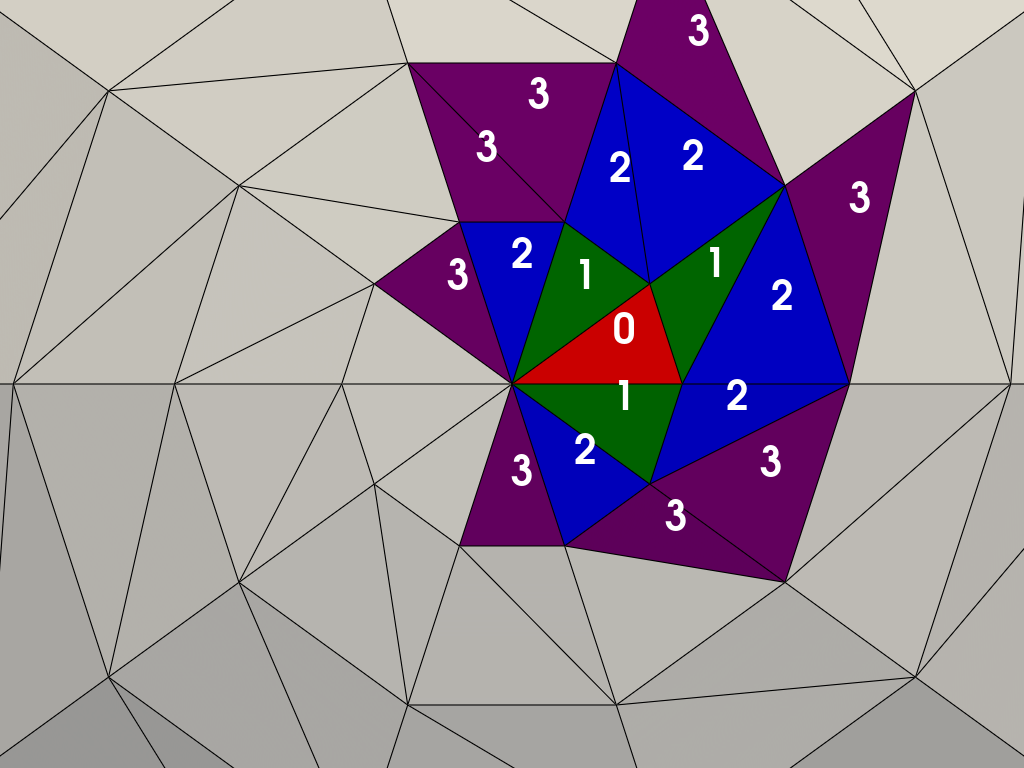
Get the cell neighbors IDs starting from the 0-th cell up until the third level.
>>> import pyvista as pv
>>> mesh = pv.Sphere(theta_resolution=10)
>>> nbr_levels = mesh.cell_neighbors_levels(0, connections='edges', n_levels=3)
>>> nbr_levels = list(nbr_levels)
>>> nbr_levels[0]
[1, 21, 9]
>>> nbr_levels[1]
[2, 8, 74, 75, 20, 507]
>>> nbr_levels[2]
[128, 129, 3, 453, 7, 77, 23, 506]
Visualize these cells IDs.
>>> from functools import partial
>>> pv.global_theme.color_cycler = [
...     'red',
...     'green',
...     'blue',
...     'purple',
... ]
>>> pl = pv.Plotter()
>>>
>>> # Define partial function to add point labels
>>> add_point_labels = partial(
...     pl.add_point_labels,
...     text_color='white',
...     font_size=40,
...     shape=None,
...     show_points=False,
... )
>>>
>>> # Add the 0-th cell to the plotter
>>> cell = mesh.extract_cells(0)
>>> _ = pl.add_mesh(cell, show_edges=True)
>>> _ = add_point_labels(cell.cell_centers().points, labels=['0'])
>>> other_ids = [0]
>>>
>>> # Add the neighbors to the plot
>>> neighbors = mesh.cell_neighbors_levels(0, connections='edges', n_levels=3)
>>> for i, ids in enumerate(neighbors, start=1):
...     cells = mesh.extract_cells(ids)
...     _ = pl.add_mesh(cells, show_edges=True)
...     _ = add_point_labels(
...         cells.cell_centers().points, labels=[f'{i}'] * len(ids)
...     )
...     other_ids.extend(ids)
>>>
>>> # Add the cell IDs that are not neighbors (ie. the rest of the sphere)
>>> cells = mesh.extract_cells(other_ids, invert=True)
>>> _ = pl.add_mesh(cells, color='white', show_edges=True)
>>>
>>> pl.view_xy()
>>> pl.camera.zoom(6.0)
>>> pl.show()