DataSet.cell_neighbors#
- DataSet.cell_neighbors(ind: int, connections: str = 'points') list[int][source]#
Get the cell neighbors of the ind-th cell.
Concrete implementation of vtkDataSet.GetCellNeighbors.
- Parameters:
- Returns:
Warning
For a
pyvista.ExplicitStructuredGrid, usepyvista.ExplicitStructuredGrid.neighbors().
Examples#
Download Python source code | Download Jupyter notebook
>>> from pyvista import examples
>>> mesh = examples.load_airplane()
Get the neighbor cell ids that have at least one point in common with the 0-th cell.
>>> mesh.cell_neighbors(0, 'points')
[1, 2, 3, 388, 389, 11, 12, 395, 14, 209, 211, 212]
Get the neighbor cell ids that have at least one edge in common with the 0-th cell.
>>> mesh.cell_neighbors(0, 'edges')
[1, 3, 12]
For unstructured grids with cells of dimension 3 (Tetrahedron for example), cell neighbors can be defined using faces.
>>> mesh = examples.download_tetrahedron()
>>> mesh.cell_neighbors(0, 'faces')
[1, 5, 7]
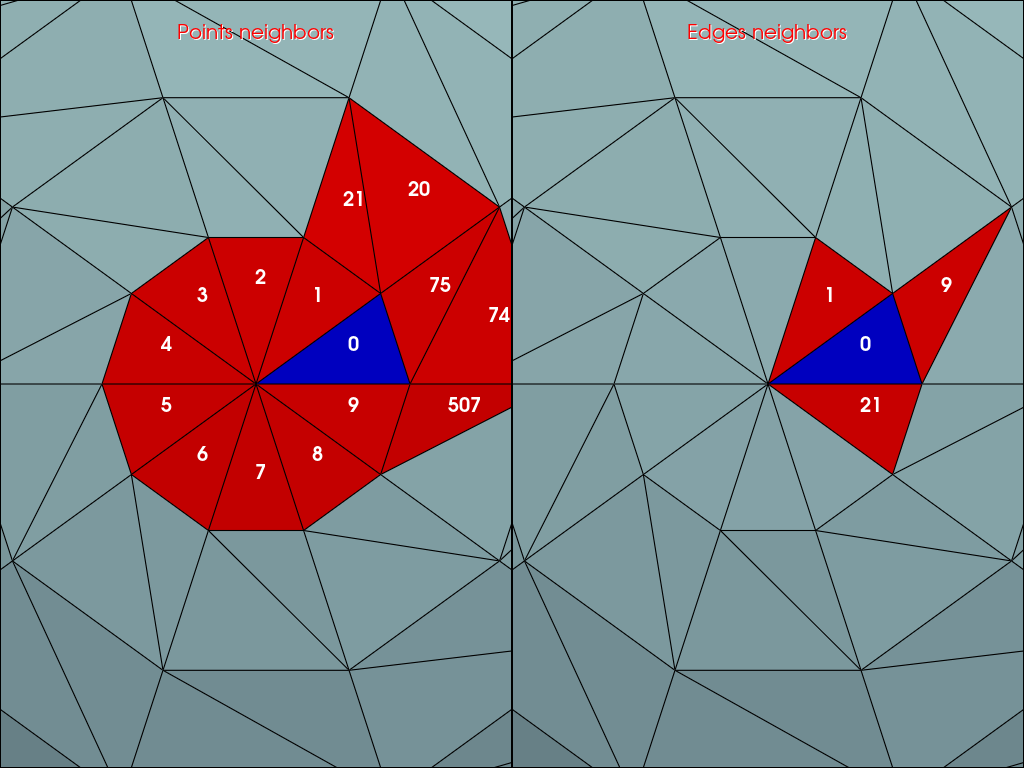
Show a visual example.
>>> from functools import partial
>>> import pyvista as pv
>>> mesh = pv.Sphere(theta_resolution=10)
>>>
>>> pl = pv.Plotter(shape=(1, 2))
>>> pl.link_views()
>>> add_point_labels = partial(
...     pl.add_point_labels,
...     text_color='white',
...     font_size=20,
...     shape=None,
...     show_points=False,
... )
>>>
>>> for i, connection in enumerate(['points', 'edges']):
...     pl.subplot(0, i)
...     pl.view_xy()
...     _ = pl.add_title(
...         f'{connection.capitalize()} neighbors',
...         color='red',
...         shadow=True,
...         font_size=8,
...     )
...
...     # Add current cell
...     i_cell = 0
...     current_cell = mesh.extract_cells(i_cell)
...     _ = pl.add_mesh(current_cell, show_edges=True, color='blue')
...     _ = add_point_labels(
...         current_cell.cell_centers().points,
...         labels=[f'{i_cell}'],
...     )
...
...     # Add neighbors
...     ids = mesh.cell_neighbors(i_cell, connection)
...     cells = mesh.extract_cells(ids)
...     _ = pl.add_mesh(cells, color='red', show_edges=True)
...     _ = add_point_labels(
...         cells.cell_centers().points,
...         labels=[f'{i}' for i in ids],
...     )
...
...     # Add other cells
...     ids.append(i_cell)
...     others = mesh.extract_cells(ids, invert=True)
...     _ = pl.add_mesh(others, show_edges=True)
>>> pl.show()