PolyDataFilters.decimate_binned#
- PolyDataFilters.decimate_binned(
- target_reduction: float | None = None,
- *,
- target_points: int | None = None,
- divisions: int | VectorLikeInt | None = None,
- point_generation: _BinnedPointGenerationOptions = 'bin_points',
- inplace: bool = False,
- progress_bar: bool = False,
Reduce the number of triangles by merging points that share a spatial bin.
The bounds of the mesh are split into a regular grid of bins, every bin collapses to a single point, and a triangle survives only when its three points land in three different bins. This uses vtkBinnedDecimation, which is threaded and typically orders of magnitude faster than
decimate()anddecimate_pro()on large meshes, at the cost of not preserving topology. It suits previews and level-of-detail rendering of very large surfaces.Give exactly one of
target_reduction,target_pointsordivisions.Added in version 0.50.
- Parameters:
- target_reduction
float, optional Fraction of the points to remove, from 0 up to but not including 1. A value of 0.9 leaves about 10% of the points. The grid is then sized as for
target_points.- target_points
int, optional Approximate number of points in the output. Cubic bins are sized over a few passes until the output is within about 5 percent of the target. Small targets can land further off, since each bin then covers a large part of the surface, and very large ones stop short when the grid reaches 2**28 bins.
- divisions
int|VectorLikeInt, optional Number of bins along each axis. A single integer applies to the longest axis of the bounds and the other axes get proportionally fewer, with at least one per axis. Three integers set each axis explicitly.
- point_generation
str, default: ‘bin_points’ How the point of each bin is chosen.
'bin_points': keep one of the input points in the bin along with its point data.'bin_averages': average the points in the bin and their point data. Smoother, and slightly slower. Integer point arrays become floating point and non-numeric point arrays are dropped.'bin_centers': place the point at the center of the bin, giving a voxelized look, with the point data of one input point.
- inplacebool, default:
False Whether to update the mesh in-place.
- progress_barbool, default:
False Display a progress bar to indicate progress.
- target_reduction
- Returns:
pyvista.PolyDataDecimated mesh.
- Warns:
UserWarningWhen
target_reductionortarget_pointsis given and the output has fewer than half of the target points, or of the input points if there are fewer.
Notes#
The filter allocates one integer per bin, so memory grows with the
product of the divisions rather than with the size of the mesh: about
1 GB at the 2**28 bins a target stops at. Explicit
divisions are not limited.
The bins span the bounds of the points used by the mesh, so a part far from the rest coarsens the whole grid and parts smaller than a bin merge away.
Points created by 'bin_centers' and 'bin_averages' are single
precision.
Examples#
Download Python source code | Download Jupyter notebook
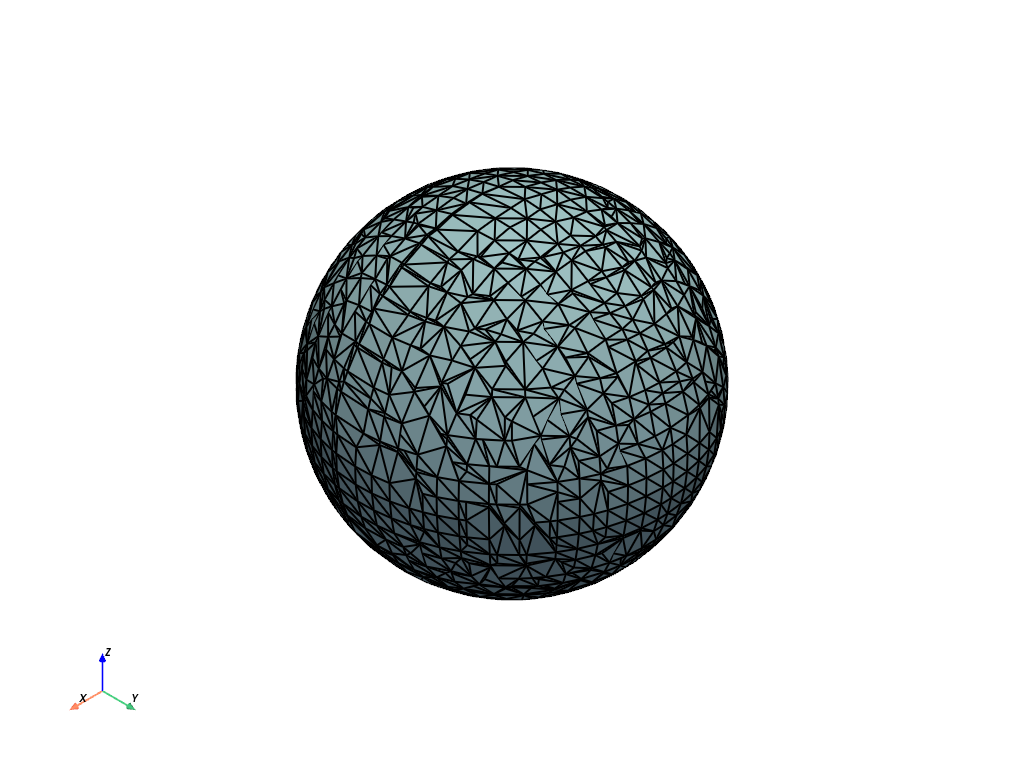
Decimate a sphere to roughly 2000 points and plot it.
>>> import pyvista as pv
>>> sphere = pv.Sphere(theta_resolution=200, phi_resolution=200)
>>> decimated = sphere.decimate_binned(target_points=2000)
>>> decimated.plot(show_edges=True, line_width=2)
Remove about 90% of the points.
>>> decimated = sphere.decimate_binned(0.9)
Use an explicit bin grid, averaging the points in each bin.
>>> decimated = sphere.decimate_binned(
...     divisions=20, point_generation='bin_averages'
... )
See Also#
decimateQuadric decimation, slower and closer to the input.
decimate_proTopology-aware decimation of triangular meshes.
Used In#
Gallery Examples