DataObjectFilters.extract_all_edges#
- DataObjectFilters.extract_all_edges( ) PolyData | MultiBlock[source]#
Extract all the internal/external edges of the dataset as PolyData.
This produces a full wireframe representation of the input dataset.
- Parameters:
- use_all_pointsbool, optional
Deprecated since version 0.44.0: Parameter
use_all_pointsis deprecated since VTK < 9.2 is no longer supported. This parameter has no effect and is alwaysTrue.- clear_databool, default:
False Clear any point, cell, or field data. This is useful if wanting to strictly extract the edges.
- progress_barbool, default:
False Display a progress bar to indicate progress.
- Returns:
pyvista.PolyData|pyvista.MultiBlockEdges extracted from the dataset. Every dataset gives a
PolyData, and aMultiBlockgives aMultiBlockofPolyDatablocks, nested blocks included.
Examples#
Download Python source code | Download Jupyter notebook
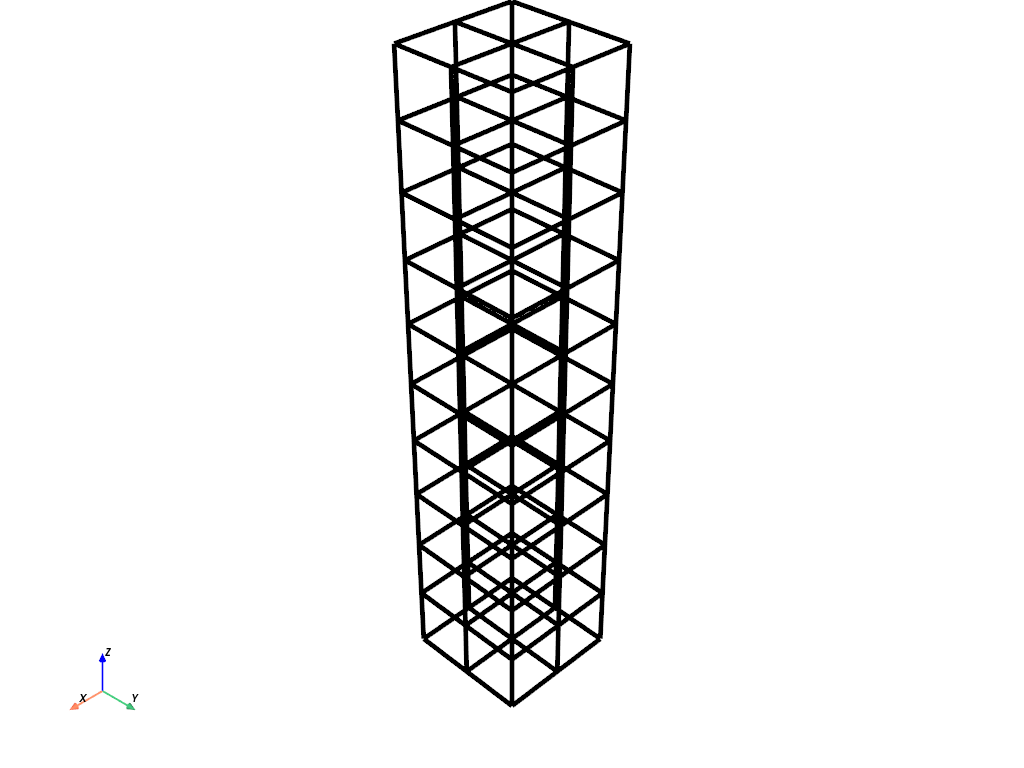
Extract the edges of a sample unstructured grid and plot the edges. Note how it plots interior edges.
>>> import pyvista as pv
>>> from pyvista import examples
>>> hex_beam = pv.read(examples.hexbeamfile)
>>> edges = hex_beam.extract_all_edges()
>>> edges.plot(line_width=5, color='k')
See Also#
pyvista.PolyDataFilters.dash_linesSplit the line cells into dashes.
pyvista.PolyDataFilters.tubeGenerate a tube around each line.
pyvista.Actor.line_styleDash the lines while rendering them.
Used In#
API Examples
Actor.line_style(1 use)DataSetFilters.delaunay_3d(1 use)DataSetFilters.extract_values(1 use)PointSet.delaunay_3d(1 use)PolyDataFilters.dash_lines(1 use)
Gallery Examples